I learned to save so I could leave.
That is the honest beginning of this story.
Frugality is not the villain. Frugality is why the door existed.
Years of saving more than we spent. Years of not upgrading things that still worked. Years of letting the accounts compound quietly in the background while life kept asking for more money, more time, more attention.
That discipline mattered.
It helped me walk away from a 17-year career in 2022. It helped us look at the cost of two kids in care — roughly $50,000 a year after tax — and ask the question I had avoided for too long: am I really going to keep trading my hours for money so I can pay someone else to spend those hours with my children?
Frugality helped us say no.
It helped us move to Portugal. It helped us lower our cost of living. It helped us create space. It helped us build the kind of freedom most people only talk about in the abstract.
So I will never mock frugality.
But I will tell you the part that surprised me.
The habits that helped me get free did not automatically know when their job was done.
The tool built the door. Then it tried to keep guarding it.
The program kept running
We moved somewhere our monthly spending dropped by more than half. The plan had worked. The pressure had changed.
And still, I caught myself cooking dinner at home night after night in a country where eating out could be affordable enough to barely register.
Portugal is full of grilled fish, warm bread, small restaurants, new flavors, the exact kind of daily experience people imagine when they say they want to live abroad.
And there I was, standing in the kitchen again.
Not because we needed to save the money.
Because some old part of me still filed restaurants under splurge.
Nobody was grading me. Nobody was coming to take away the gold star if I ordered the fish. The spreadsheet did not need the win.
But the program kept running anyway.
That is the trap.
Not that frugality is bad. Not that saving is wrong. Not that discipline should be discarded the moment you have a little breathing room.
The trap is when a tool that once protected you becomes a rule you no longer examine.
The trap is when the thing that built the door becomes the thing that keeps you from walking through it.
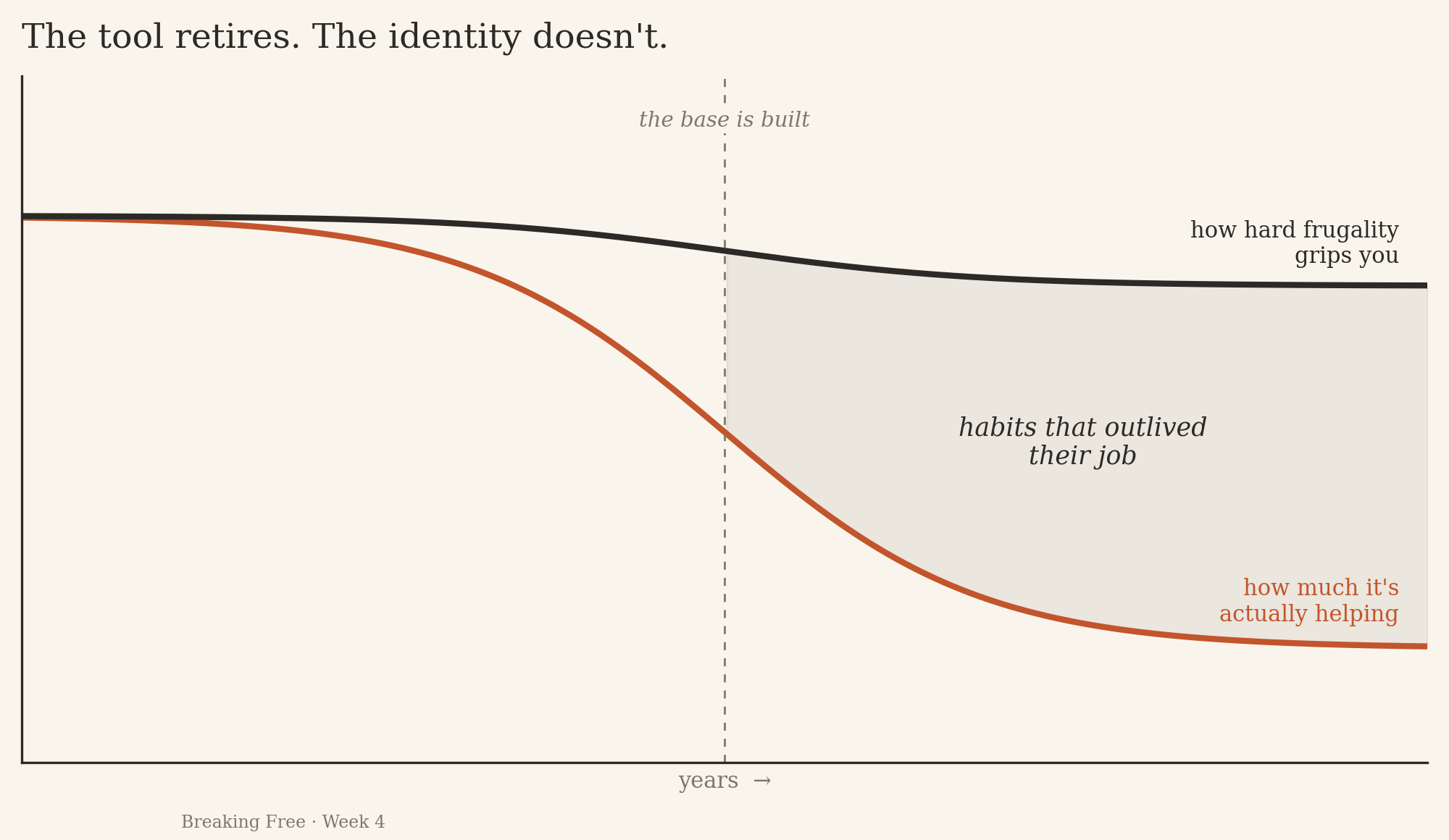
The tool retires. The identity does not — unless you make it.
The cage you are proud of
This is the part serious savers do not like to admit: frugality can become an identity.
At first, it is just behavior. You compare prices. You repair instead of replace. You cook at home. You drive the older car. You delay gratification because you are buying something more important than whatever is in front of you.
Freedom. Options. Safety. Time.
Then the behavior works.
And because it works, you start to trust it. Then you start to admire it. Then you start to become it.
You are not merely a person who saves money. You are responsible. You are disciplined. You are not like those people who waste what they earn.
You have proof.
The accounts grew. The plan worked. The number moved.
And now questioning the habit feels like questioning the person.
That is why the math does not fix it.
You can show yourself the balance. You can run the projection. You can prove, in cells and formulas, that the dinner is fine, the flight is fine, the cleaner is fine, the better mattress is fine, the help is fine.
But identities do not respond to spreadsheets.
A habit asks, does this still serve me?
An identity says, this is who I am.
And once frugality becomes who you are, spending does not feel like using money.
It feels like betrayal.
Scarcity does not check the balance sheet
There is a nervous-system part of money that most financial writing skips because it does not fit neatly into a calculator.
The lived experience of not having enough writes patterns into you. Sometimes those patterns are useful. They make you resourceful. They make you careful. They make you respect money instead of treating it like air.
But patterns are not wisdom just because they are old.
You can have the emergency fund, the portfolio, the paid-off debt, the lower monthly expenses, the sensible plan — and still feel the old hum when you reach for your wallet.
What if this is irresponsible?
What if the investments do not grow?
What if we have less than I think?
What if this is the mistake?
That voice is not always financial intelligence. Sometimes it is just fear holding a calculator.
I know that voice.
It was there when I left work. It was there when we moved. It was there when I looked at the accounts and still wondered whether we had enough. It was there even after the numbers said the decision was reasonable.
The scarcity had changed.
My body had not caught up.
That gap is expensive.
It costs you dinners you would have remembered. Trips you could have taken while the kids still wanted to come. Help you could have hired during the years when your time was most crowded. Energy you could have used for work that matters, for health, for marriage, for community, for being present instead of being proud that you saved another dollar doing something you hated.
And maybe the most uncomfortable part: it teaches the people watching you.
Including the small ones.
They may not understand the spreadsheet. But they understand the feeling in the room. They understand whether money is a tool or a threat. They understand whether life is something we are building or something we are constantly bracing against.
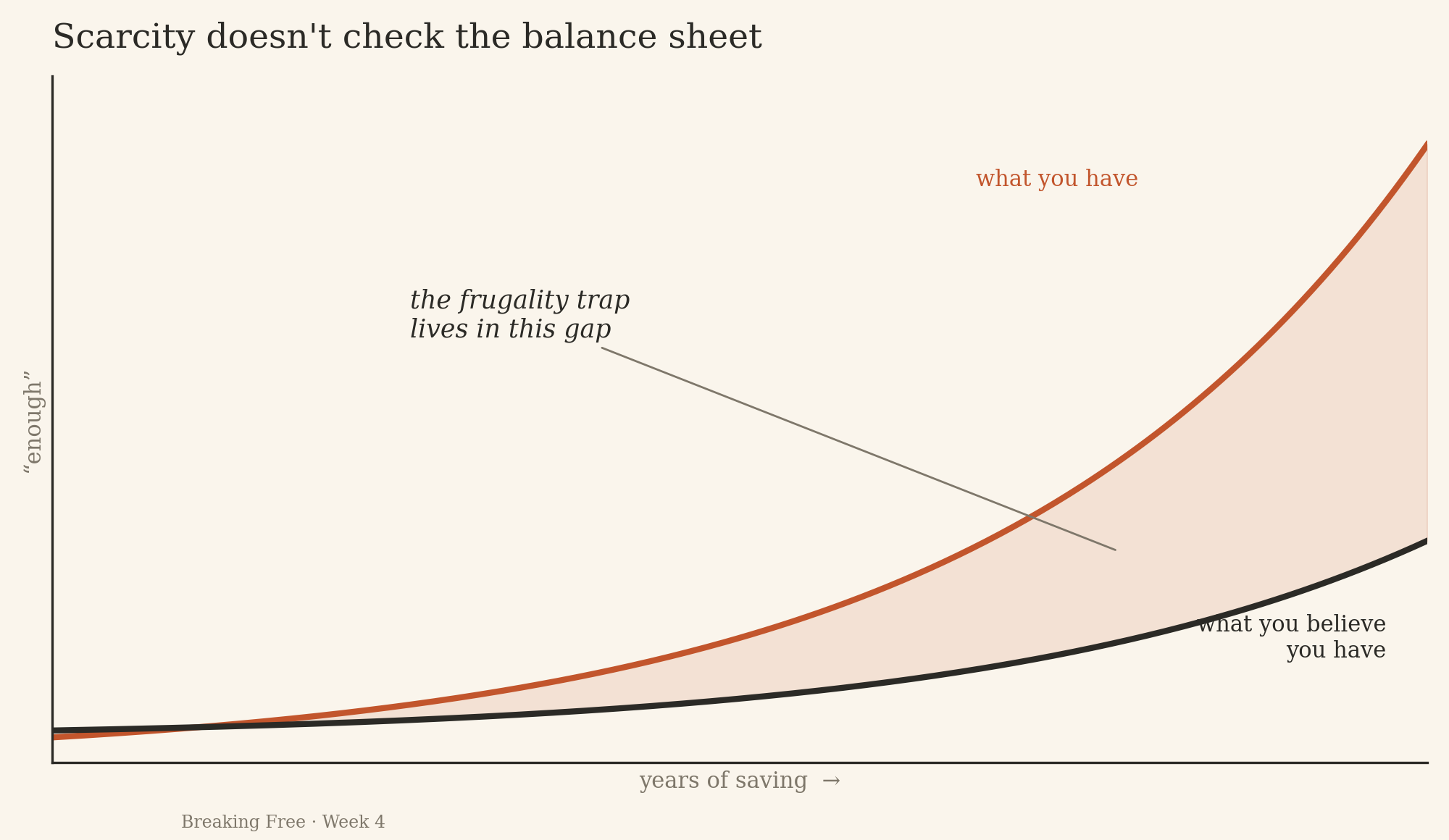
The trap is not the number. It is the gap.
Financial freedom is not just reaching the number.
It is the day you begin to believe the number enough to live differently.
The wrong question
Most people ask, can I afford this?
That is a useful question early on. Sometimes it is the only question. If you are in debt, unstable, paycheck to paycheck, or trying to build your first real cushion, can I afford this matters.
In that stage, frugality is not a cage. It is a ladder.
But eventually the question has to mature.
Not disappear. Mature.
The better question is: what is this purchase buying back?
Is it buying time?
Is it buying energy?
Is it buying a memory?
Is it buying health?
Is it buying a little less resentment at the end of a long day?
Is it buying your attention back from a task you neither enjoy nor do well?
That question changes everything.
A cleaner is not just a cleaner. It may be two hours back and one less fight over the state of the house.
Delivery is not just laziness. It may be the difference between a frantic evening and a calm one with your kids.
A dinner out is not just food you could have cooked cheaper. It may be the experience you moved across an ocean to have.
A flight is not just an expense. It may be the relationship you keep alive.
A better mattress is not indulgence if sleep is the thing that determines the quality of every waking hour.
The point is not to justify every purchase. That is just consumerism with better language.
The point is to stop treating every dollar not spent as automatically virtuous.
Sometimes the saved dollar is the waste.
The thing frugality cannot decide for you
Frugality is excellent at one thing: creating margin.
It can help you get out of debt. It can help you build an emergency fund. It can help you invest. It can help you create the space to make a major move, change careers, step away from work, or stop living with a constant low-grade panic in your chest.
But frugality cannot tell you what the margin is for.
That part is your job.
And if you never answer it, frugality will keep doing what it knows how to do. It will keep preserving. Keep delaying. Keep protecting. Keep stacking more safety on top of safety.
You will call it discipline.
But underneath, it may be avoidance.
Avoiding the risk of choosing.
Avoiding the vulnerability of wanting.
Avoiding the grief of admitting how much life you postponed while you were being responsible.
That is the harder freedom.
Not the freedom to stop working.
The freedom to stop proving you deserved to.
Try this before Sunday
Philosophy without an assignment is just mood, so here is the assignment.
Pick one thing you have been deferring that you can plainly afford.
Not something reckless. Not something performative. Something real.
The dinner. The help. The flight. The better shoes. The sitter. The mattress. The headphones you have researched for six months and somehow never bought.
Buy it this week.
Then watch two moments closely.
First, the resistance right before.
That is the old identity defending itself. It may sound responsible. It may say, do we really need this? It may say, this is how people get careless. It may say, what if this is the beginning of the slide?
Listen to it.
Then buy the thing anyway, if the numbers plainly support it.
Second, watch what happens after.
Usually nothing catastrophic happens. No financial collapse. No moral failure. No sudden unraveling of the life you built.
Sometimes there is even relief.
Not because the thing saved you.
Because you practiced believing the work you already did.
One purchase will not rewire your relationship with money. But it starts a different kind of compounding. Each act of trusting the number makes the next act a little less expensive emotionally.
That is also financial freedom.
The quieter exit
Breaking free is not just leaving the job.
It is not just moving countries.
It is not just reducing expenses, building the portfolio, or reaching the number.
Those are the visible exits. They matter. They are real.
But the quieter exit is leaving the story about who you have to be to stay safe.
For a long time, mine was frugality.
It protected me. It served me. It helped me build a door.
Now the work is learning how to walk through it without apologizing.
The question is not whether frugality helped you build the life. The question is whether you are still letting it keep you from living it.
Next Tuesday, we will get practical: how to buy back your time without turning spending into another mindless habit.
Reply and tell me: what is one thing you can clearly afford, but still feel guilty buying — and what does the voice in your head say right before you buy it?
— Ashleigh