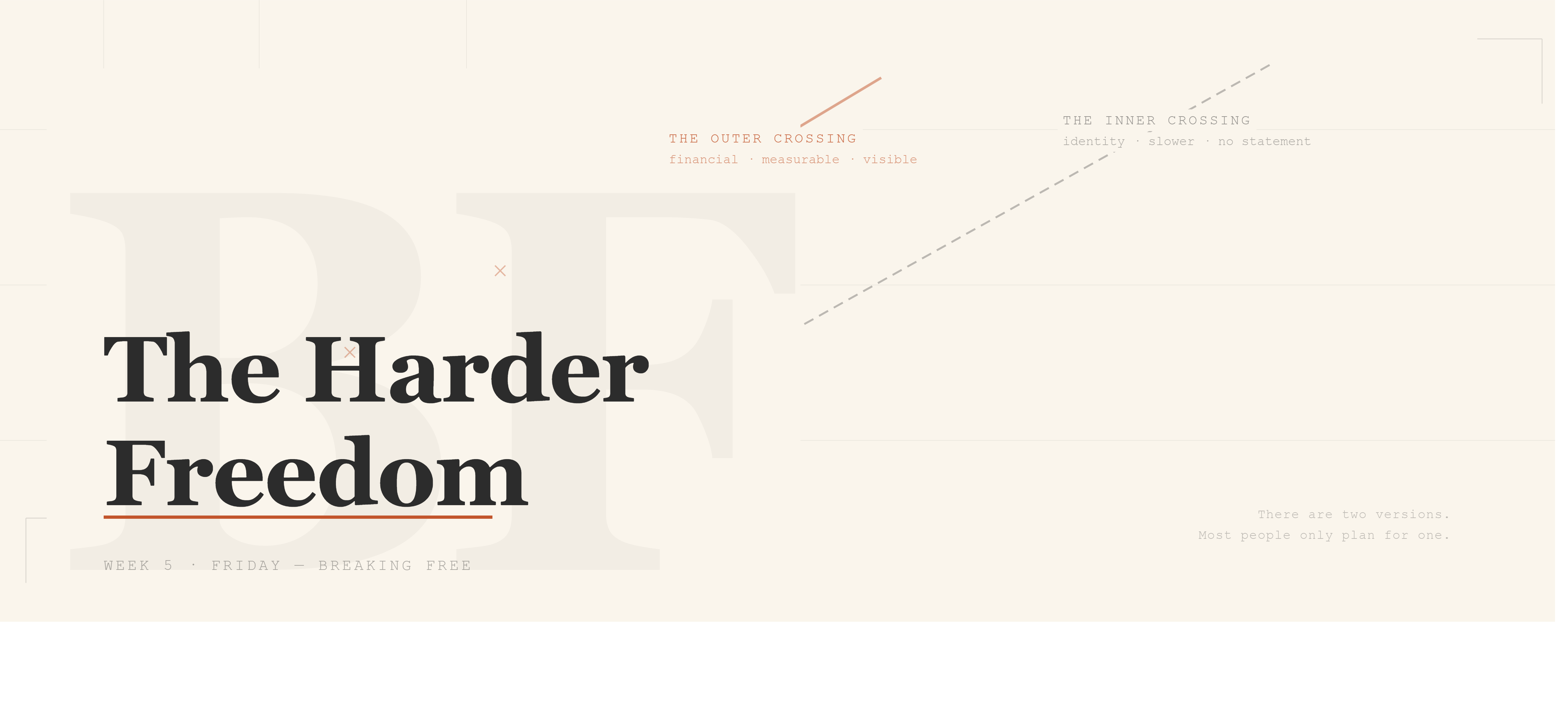
There’s a version of breaking free that’s mostly visible.
You quit the job. You run the math and the numbers work. You move somewhere cheaper, or better, or different — or you stay and renegotiate what staying means. You build the accounts. You stop trading time for things you don’t actually want. You earn back enough margin that your next move is a choice instead of a necessity.
That version is real. It matters. And if you’re reading this publication, you’re probably somewhere on that path — maybe at the beginning, maybe well into it.
But there’s a second version that doesn’t show up on a statement, and most people don’t find it until they’re deep enough into the first one to notice it isn’t finished.
What the money doesn’t fix
Here’s what I’ve been sitting with.
I left a 17-year career, moved the family to Portugal for a few years, built the publication, and did most of the external work the Breaking Free thesis describes. None of that is nothing. But somewhere in the middle of all of it, I started noticing that I was still running old code.
Not financially. The accounts are fine. The math holds.
I mean the internal version — the patterns about what ambition is supposed to look like, whose definition of success I’d been calibrating to, the ways I’d learned to measure my own value that had nothing to do with what I actually valued. The habits of performing a version of myself that no longer fit the life I was building.
The outer moves don’t automatically update those. That’s the part nobody tells you.
The script you didn’t write
Most of us absorbed a set of instructions for how to be a person — specifically, what a successful, respectable, functioning adult looks like. Career trajectory. Income benchmarks. How you present in a room. What you do with your Saturday. What you’re allowed to say you want.
Some of those instructions fit. Some were never yours. And you usually can’t tell which is which until you stop running them long enough to look.
That’s not therapy-speak. It’s the same logic as the budget. A budget works because you force yourself to see where the money is actually going, not where you assume it goes. The same audit applied to your identity is harder and slower — but it’s the same move. Where is your energy actually going, and is that where you would choose to send it if you were choosing?
Most people never ask the question. Not because they’re incurious, but because staying busy is a very effective way to not have to.
Doing the work mid-crossing
Here’s the thing I’ve come to believe: you don’t have to wait until the outer life is resolved to start the inner work. You don’t need the transition to be finished, the new chapter fully formed, the uncertainty cleared before you’re allowed to examine what you’re running on.
Actually, the middle of the crossing is exactly when it matters most. Because the old life gave you structure and identity even when it didn’t fit. When you leave — when the scaffolding comes down — you find out what was load-bearing and what wasn’t. The fear that drove you, the identity built around performance, the values you inherited versus the ones you’d choose: all of it becomes visible in the open air.
That’s uncomfortable. It’s also the whole point.
I’ve been doing deliberate work on this — looking at the patterns I built for a different life and asking which ones come with me. Not all of them should. Some of what got me here is exactly what I need to leave at the door.
The through-line
Breaking Free started as a publication about money and time. It still is. Getting the finances right, building the margin, understanding the mechanics — that work is real and it matters, and we’ll keep doing it here every Tuesday.
But I want to be honest about where the thesis leads, because it has always led here.
The financial work clears the ground. It removes the most obvious constraints, the ones you can measure and solve. What you build on that cleared ground — who you decide to be when the job title and the income and the structure are no longer doing the work of answering that question for you — that’s the part that takes the longest.
That’s the harder freedom: the version no statement can show you, and no amount of money can buy you out of.
And it turns out you have to earn it the same way you earned the other kind: not by waiting until the conditions are right, but by doing the work in whatever conditions you’re actually in.
You can quit the job and still be reporting to the version of yourself who couldn't.
Next Tuesday: the mechanics of the nest-egg tipping point — the moment when your invested capital can grow faster than your salary, and what changes when the job becomes a choice rather than a necessity.
Reply and tell me: What’s one pattern you’re still running that you know you didn’t choose — and what would it look like to actually examine it?
— Ashleigh