The index-fund people are right. Almost.
Dollar-cost average into a low-cost total market index fund, hold through every downturn, don’t touch it — you will beat the majority of professional money managers over any twenty-year stretch. This isn’t controversial. It’s one of the most replicated findings in finance. If you’re not doing this with the bulk of your savings, stop reading this post and go do that first.
Okay. If you’re still here, let’s talk about the part they leave out.
There exists a narrow slice of the market — mostly ignored, under-researched, too small for the institutions to bother with — where patient, thorough individual investors genuinely can and do find an edge. I know this because I’ve spent years in it. I’ve sat on quarterly calls with CEOs of companies with $80 million market caps. I’ve read filings nobody reads. I’ve held positions through 50%+ drawdowns because I understood the business better than the price.
One of those positions became the best return I’ve ever had in the market — a multi-year hold that turned into a double-digit multiple on the original investment, in a company most professional investors had never heard of. I’m not going to name it or give you the exact number, and that’s on purpose: the moment I do, this stops being a disclosure about process and starts sounding like a pitch for a specific stock — and that’s not what this newsletter is for, or what I’m licensed to do.
This isn’t a brag. It’s a disclosure. If I’m going to tell you whether stock picking is worth your time, I should tell you what I’ve actually done.
Why most stock pickers fail
The research is brutal. Over ten-year periods, roughly 90% of actively managed funds underperform their benchmark index. Individual investors do even worse on average, mostly because they trade too often, buy after rallies, sell after crashes, and confuse familiarity with understanding. I’ve been those people too.
The reason this happens isn’t that the market is too efficient to beat. It’s that the wrong people are trying to beat it in the wrong places.
Large-cap stocks — your Apples, your Amazons, your S&P 500 constituents — are analyzed obsessively. There are hundreds of analysts with Bloomberg terminals and channel checks and expert networks competing to know the same thing one day faster. In that environment, you — reading the 10-K at home on a Saturday — don’t have edge. The price already reflects more information than you have.
That is not true everywhere.
The edge in small and micro-caps
A company with a $60 million market cap is too small for Fidelity to buy. Too small for most institutional managers to justify the research hours. Too small to make headlines. Often, it’s covered by zero analysts.
Which means: the price reflects far fewer eyeballs, far less diligence, and often far more emotion than fundamentals. The market for these companies is genuinely inefficient in a way the large-cap market isn’t.
This is where individual investors can compete — not by having faster data, but by being willing to do the work that institutions can’t be bothered to do. It’s information arbitrage. Not inside information. Not tips. The opposite: finding companies where public information is abundant but ignored, and doing enough work that you understand the business better than the current price suggests.
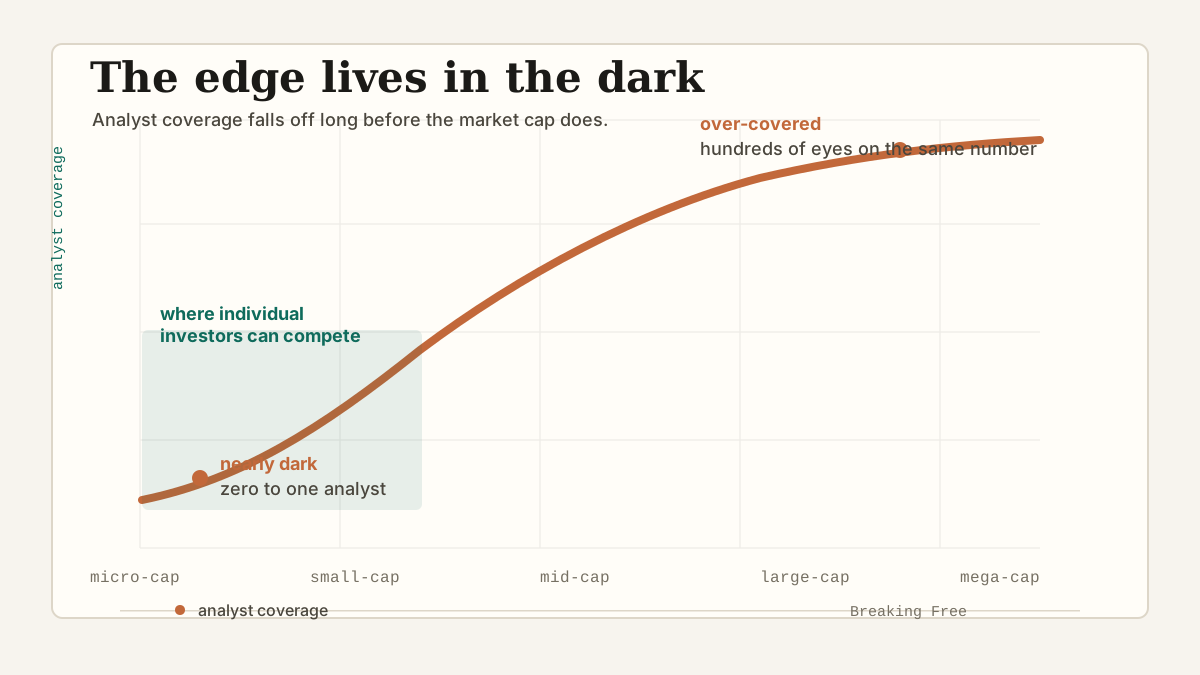 Analyst coverage vs. market cap: large-caps are over-covered; micro-caps are nearly dark. Edge lives in the lower left.
What the work actually looks like
A few principles I’ve calibrated over years of doing this, some of which I learned from Ian Cassel — who runs MicroCapClub and has articulated this philosophy better than almost anyone:
Understand before you buy. This sounds obvious and it’s the thing most people skip. Can you explain in two sentences why this company will be worth more in five years than it is today? Not “it’s cheap.” Why specifically. If you can’t, you don’t understand it well enough yet.
The business, not the price. Amateur investors watch the stock. The work is understanding the business — its competitive position, its customers, its costs, its management’s track record of capital allocation. If those things are sound, the price takes care of itself over time. Usually.
Know what you don’t know. Every thesis has a list of ways it’s wrong. Write that list. The investors who blow up aren’t the ones who got things wrong — they’re the ones who weren’t aware they could be.
Your edge is patience. Institutions can’t hold an illiquid micro-cap through a bad quarter without getting redemption pressure. You can. That’s real edge if you actually have the conviction and the constitution.
Concentration. You need to hold enough of a position for a 3x to matter. That means you can’t own 30 micro-caps. Know maybe 5-8 businesses extremely well. This is not advice to go put your life savings in one stock; it’s a note that diversification and this kind of investing are somewhat in tension.
The honest limitations
This takes genuine time. Not “I listen to a podcast on my commute” time — real hours. Filings, annual reports, industry research, sometimes picking up the phone. If you have the interest and the intellectual appetite, that’s just a fun hobby that happens to be remunerative. If you don’t, it’s a grind you’ll abandon exactly when discipline matters most.
And the volatility is extreme. That best-performing position went through periods where it was down 40%. I stayed because I understood the business hadn’t changed. If you don’t understand the business that deeply, you won’t stay.
The people who should try this: curious investors who genuinely enjoy the research, have a full emergency fund and stable savings rate, and can emotionally tolerate seeing positions fall by half without panicking.
The people who should absolutely not: anyone who thinks this sounds easier than indexing, or who has never read a 10-K, or whose investment thesis is “the CEO seems sharp on CNBC.”
This week: define your circle of competence
One concrete question: in what industry or domain do you have genuine expertise — not interest, expertise — that the average investor doesn’t?
Former supply chain manager? You understand inventory dynamics in ways a finance analyst might miss. Healthcare professional? You can read clinical data. Real estate background? You know what $85 per square foot actually means in a specific market.
Your career might be your investing edge, if you’re willing to look for it in the right size companies.
Indexing is the right answer for most money. This is the question of what to do with the slice you're willing to put in real work for.
Friday: what happens after you actually win the financial game — the part nobody warned me about, and the thing I’ve been working through since coming back from Portugal.
Reply and tell me: Have you ever owned an individual stock you actually researched deeply — or does the idea sound either thrilling or completely overwhelming?
— Ashleigh