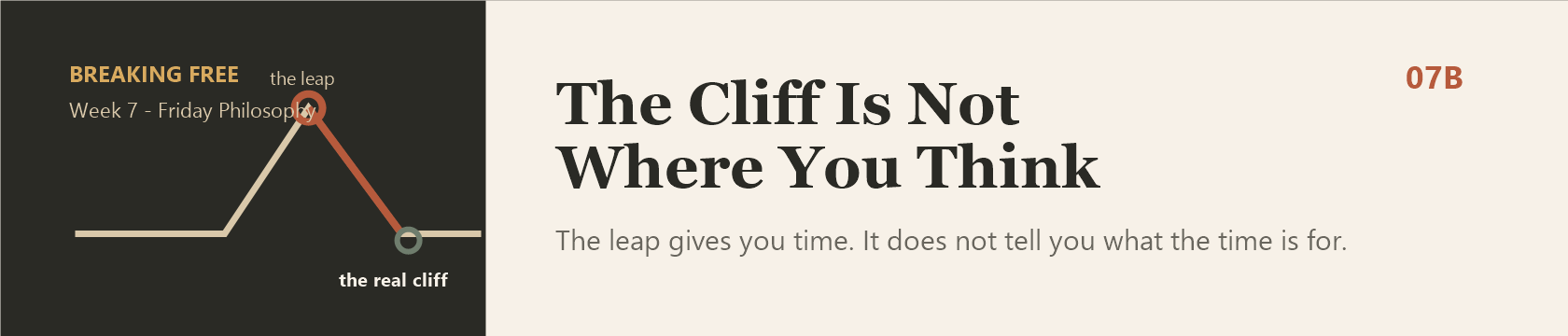
Everyone worries about the leap: the resignation email, the first month without a paycheck, the moment your old title stops introducing you before you have to introduce yourself.
That part is hard. I will not pretend otherwise.
But that is not the cliff.
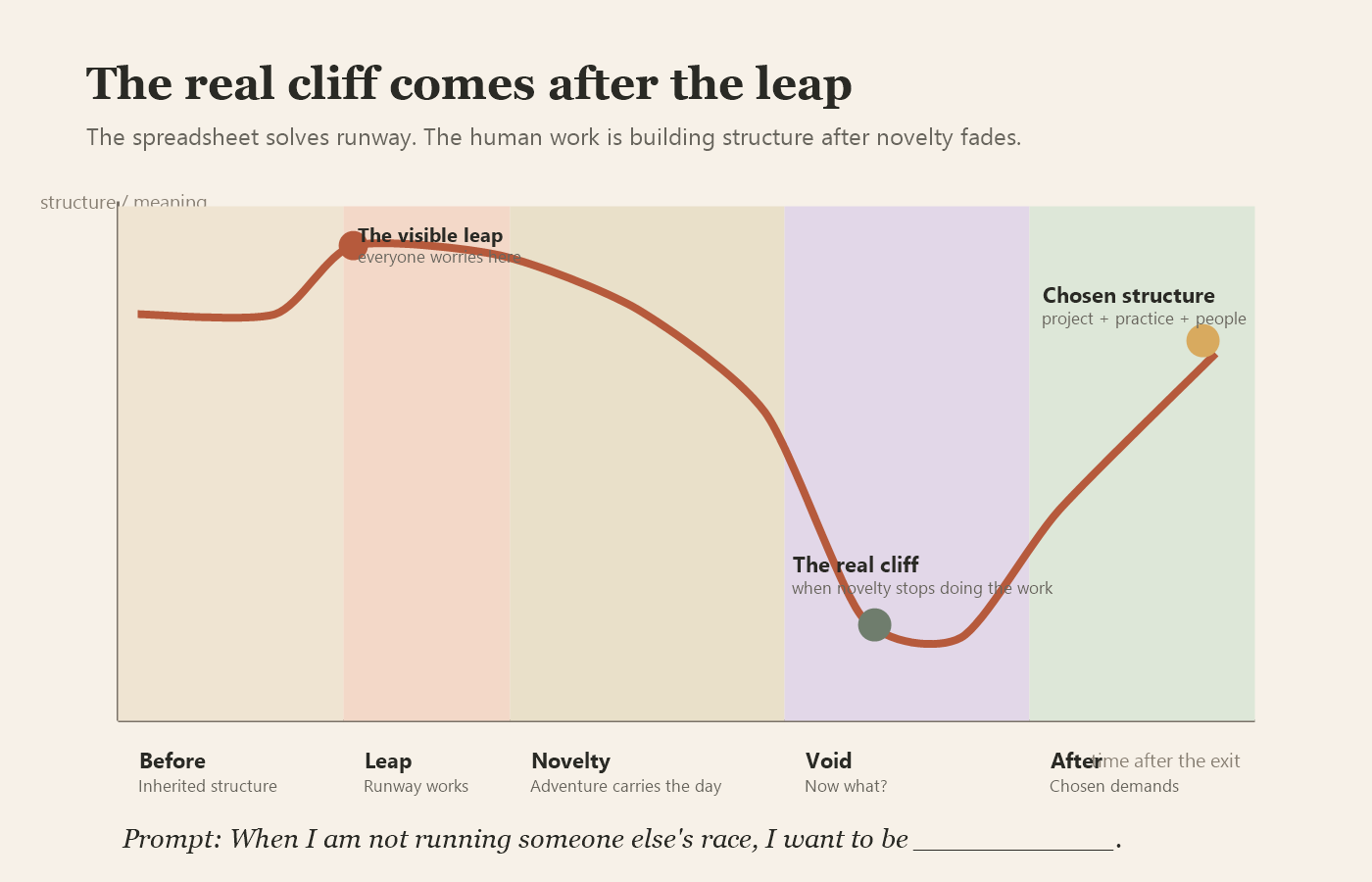
The cliff comes later, when the novelty wears off and the calendar stops telling you who to be.
The leap gives you time. It does not tell you what the time is for.
The spreadsheet answer
The spreadsheet answer is the one everyone can see. How many months or years can our savings cover our expenses? What does health insurance cost? What happens to taxes? How much can we spend without salary? What happens if the market drops?
These are real questions. They matter. I am not interested in pretending courage is a substitute for math. Your dream still needs a model.
But once the model works, another question shows up.
Now what?
That is the question I underestimated.
When Portugal became a place
When we arrived in Portugal, the first chapter felt like proof. The kids were adjusting. We were exploring. Every week brought something new: a neighborhood, a restaurant, a beach, a person we would not have met otherwise.
The life we had been planning was happening.
For a while, novelty did a lot of the work. It gave the days shape. It made ordinary things feel meaningful. Grocery shopping counted as adventure because the labels were different and I was still figuring out which fish was which.
Then, slowly, Portugal stopped feeling like a leap and started feeling like a place.
A good place.
But still a place.
I remember one ordinary day when nothing was wrong. That was the strange part. The kids were fine. The weather was good. We had built the life we had talked about building. I had more time than I used to have. More flexibility. More control. More of the thing I thought I was trying to buy back.
And still, I felt the question underneath the quiet:
What am I doing with this?
Not in a dramatic way. No crisis. No regret. No we made a mistake. Just the uncomfortable realization that freedom had solved one problem and revealed another.
The job was no longer consuming the day.
But that meant the day was mine to answer for.
That is the post-leap void: not regret, not failure, but the moment when freedom stops being new and starts asking for direction.
What the job was doing
The job was not just paying you. It was structuring your day, naming your identity, handing you a tribe, and giving you a clean answer when someone asked, “What do you do?”
That structure can be suffocating when it no longer fits. But it is still structure.
When you leave, you take back the time. That part is beautiful. You also lose the scaffolding.
And if the job held your identity for long enough, building a new one can feel strangely disorienting. I had spent seventeen years being good at something. Even after I knew it was no longer mine, it had still been useful to be legible.
Leaving gave me freedom.
It also took away the easy explanation.
The human answer
The spreadsheet says: you bought back your time.
The human question is: what are you going to become with it?
That is where people get caught. They treat the crossing as the destination. They finish the marathon, sit down at the finish line, and slowly realize there was supposed to be a next thing.
The people I have watched navigate this well usually had something waiting on the other side. Not necessarily a company. Not necessarily a grand mission. But a project, a practice, a community, a craft, a body of work. Something with enough structure to keep them from drifting and enough meaning to make the effort worth choosing.
They did not escape effort.
They changed who the effort was for.
On atrophy
Freedom without purpose does not leave you unchanged. You change. Just not always in the direction you hoped.
Health can atrophy if no structure makes you move. Friendships can atrophy if you assume community will happen naturally. Your edge can atrophy if nothing is demanding your best thinking anymore.
This is not inevitable. But it is the default if you never build a different structure.
I have been sitting with this more since coming back to California. The Portugal chapter gave me space. It gave me family time. It gave me perspective. It gave me a different menu.
But space is not the same as direction.
I still want demands. Not inherited demands. Not the old calendar filling itself with someone else’s priorities. Chosen demands.
The kind that make me sharper, more useful, more alive.
The goal was never to avoid work.
The goal was to stop spending my best energy on work that no longer felt like mine.
What comes after
I do not have a tidy answer here. I trust people less when they do.
But I do think the sequence matters.
The financial work comes first because pressure is loud. It is hard to hear yourself think when the account is draining and every question sounds like a threat. Runway matters. Tax planning matters. Cash flow matters. The numbers matter.
But the numbers are the before.
At some point, you have to build the after. And the after is not just travel more or spend time with family. Those are good things. They may even be sacred things. But they are not always enough structure for a whole life.
The after has to draw on what you are actually capable of. It has to connect you to people who take something seriously. It has to make you grow, or at least make you feel the resistance that means you are trying.
You probably already know what it is. It is usually the thing you keep saying you would do if you had more time.
You are building the time.
Start taking seriously what you are building it for.
If you are still building the financial side, start with the free career-break planner. It will show whether the current version is funded. Then come back here and answer what the funded time is for.
This week
Write this sentence:
When I am not running someone else’s race, I want to be ____________.
Fill it in honestly. Not aspirationally. Not with the answer that sounds impressive. With the answer that feels true enough to make you uncomfortable.
If nothing comes, that blank is not a failure.
It is the work.
And no spreadsheet can fill it for you.
The leap gives you time. The harder freedom is deciding what the time is for.
Next Tuesday: the numbers you keep avoiding, and why messy numbers create more anxiety than bad numbers.
Reply and tell me: Did you expect the post-leap void, or did it catch you off guard? If you are still before the leap, does this change how you are planning it?
— Ashleigh