Everyone says to keep your books clean for tax season.
That advice is not wrong. It is just aimed at the wrong audience.
The IRS is not the person your books are for.
You are.
I have spent a lot of my career as the person who gets handed the messy numbers: as a CPA, as a controller, in private-equity real estate, and now with owners and households trying to make better decisions. The pattern took me years to name, mostly because it never shows up in the file itself.
Messy numbers are not just disorganized. They are anxious.
The mess is rarely only a bookkeeping backlog. It is a pile of decisions the owner has quietly stopped making. Can I afford to hire? Don’t know, so don’t ask. Is that service line actually profitable? Don’t know, so keep doing it. How long can we survive a slow quarter? Don’t know, so lie awake and call it being responsible.
The spreadsheet answer says the business is fine: revenue is coming in, the card does not decline, nobody is yelling yet.
The human answer is that the owner has not opened the accounting file in four months because every time they do, it costs them a night of sleep.
Fear is a visibility problem
Most financial content treats disorganized money as a discipline problem. Reconcile more. Categorize better. Close your books faster. Use better software.
Fine. Those things help.
But they miss the emotional engine.
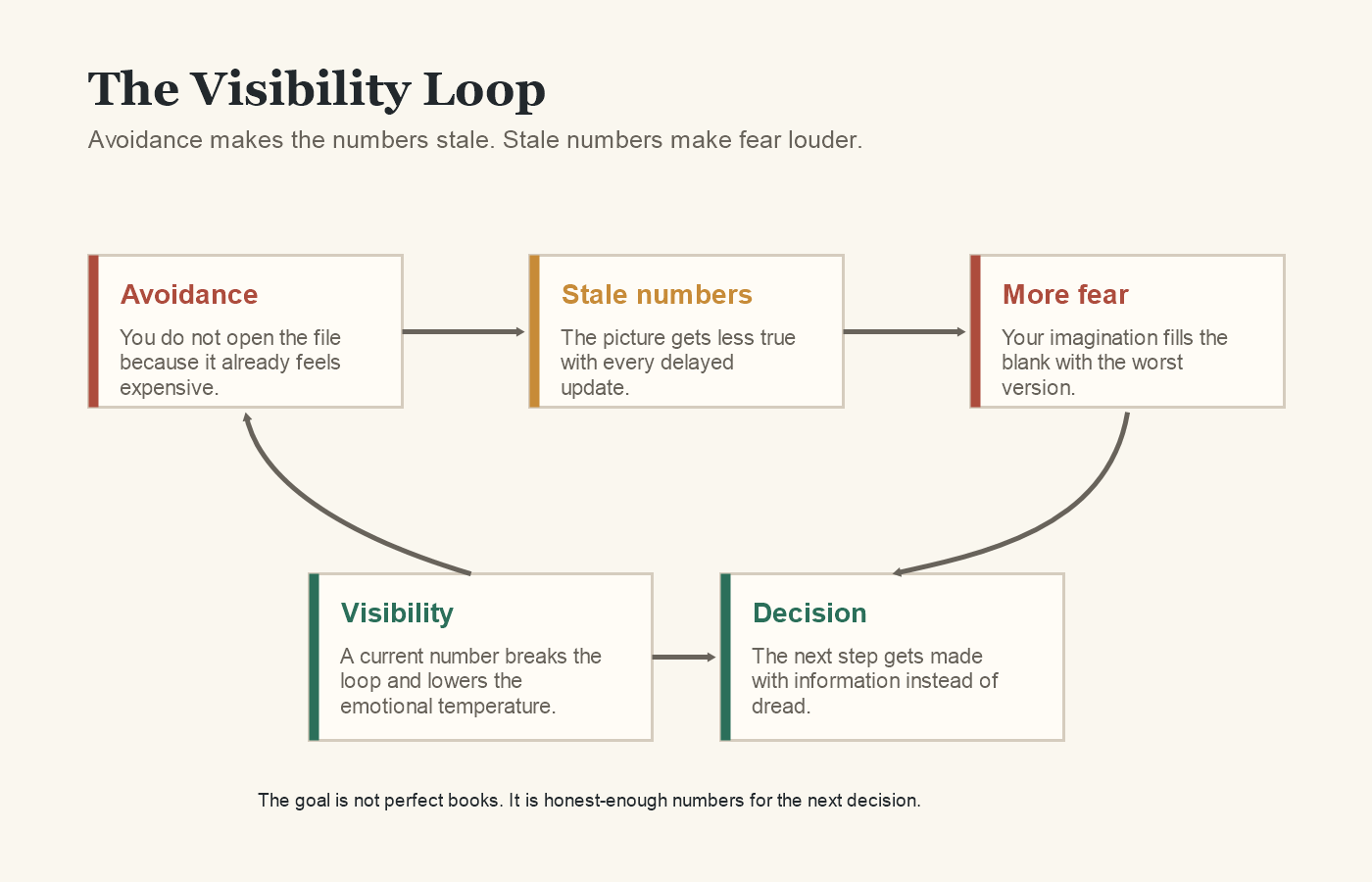
You avoid the numbers because they make you anxious. The numbers get stale because you avoid them. Then the fear grows precisely as fast as the staleness does, because your imagination is a much harsher accountant than your actual books are.
Almost every cleanup I have seen starts with someone braced for a verdict. They are not opening QuickBooks or the bank account. They are walking into court.
And often, the real number is not as bad as the imagined one.
That is the part worth saying twice: the imagined number is usually worse than the real one. Fear compounds in the dark.
Good accounting is not about looking backward. It is about making the next decision with less fear.
The same disease runs at home
Swap “business” for “household” and the pattern barely changes.
The couple who fights about money every month is rarely fighting only about the spending. They are fighting about visibility: two people making decisions against two different imaginary pictures of the same bank account.
Neither picture is right.
And neither person knows it.
The tension is not always a values problem yet. Sometimes it is a data problem wearing a values costume.
This matters because you cannot spend according to your values if nobody can see what the spending actually is. Clarity has to come first. It is amazing how many “money fights” soften when both people are finally looking at the same true number.
And it is also amazing how many real disagreements, the ones worth having, only become visible then.
A clean number does not solve every conflict.
It does stop you from arguing with a ghost.
The number should answer a question
This is where a lot of accounting systems fail people.
They are organized for compliance, not decision-making. They can tell you what happened last year, but not whether you should hire, raise prices, cut a subscription, move, outsource, invest, or slow down.
A household budget can have the same problem. It can track every coffee and still fail to answer the question that matters: are we spending in a way that supports the life we say we want?
A useful financial system should answer the questions your life is actually asking.
For a business owner, that may mean:
- How much cash do I really have after taxes and upcoming bills?
- Which part of the business is creating profit, and which part is just creating activity?
- What happens if revenue drops for sixty days?
- Can I afford help, or am I buying stress with underpriced work?
For a household, it may mean:
- How much freedom do we have this month?
- What spending is making our life better?
- What spending is pure autopilot?
- Which decision are we delaying because we do not trust the picture yet?
This is why a budget is a confession. Not because it reveals whether you are good or bad with money. Because it tells the truth about what your current system is actually protecting. Maybe it is protecting convenience. Maybe it is protecting control. Maybe it is protecting the ability to avoid a conversation nobody wants to start.
The 30-minute visibility audit
You do not need perfect numbers. You need numbers honest enough to act on.
Here is the test. It works for a business or a household. Three questions, thirty minutes, no software required.
- What is your cash position today? Not roughly. The number. If finding it takes more than five minutes, that is a finding.
- What will it be in sixty days? Committed money in, committed money out. A guess written down beats a feeling. If you genuinely cannot construct this, that is the second finding.
- What decision are you currently delaying because you do not have a number for it? The hire. The price increase. The move. The cleaner. The “can we actually afford this” conversation you keep rescheduling. Name it and write it next to the number it is waiting for.
If all three took ten minutes, your system may be doing its job, even if it looks simple.
If the second question made you squirm, or the third produced a longer list than you expected, the problem was never discipline. It is that your numbers are not organized around the decisions your life is asking you to make.
That is fixable.
Some people fix it with a spreadsheet and a monthly hour. Some fix it with software. Some bring in help to turn messy numbers into a decision-ready system and then run it themselves. The method matters less than the outcome: numbers current enough and clear enough that the next decision gets made with information instead of dread.
What to clean first
If your numbers are messy, do not start by reorganizing everything.
Start with the decision that is making you anxious.
If you are worried about taxes, track how much cash is reserved for the next tax payment. If you are fighting about household spending, build a shared monthly picture. If you are afraid to hire, calculate how many months the business can pay its expenses with the cash available. If you are not sure your business is worth the effort, separate actual profit from money simply moving through the business.
The first system should answer the first real question.
Not the question an accountant wishes you had.
Not the question the software dashboard wants to show you.
The question that is costing you sleep.
That is where clarity starts to feel like freedom instead of admin.
Visibility lowers fear. The books were never for the IRS. They are for the version of you that has to decide what happens next.
Keep reading
If this piece is about making the numbers visible, A Budget Is a Confession is the home version of the same idea: your spending is already telling the truth about what your system protects.
If you want the investor lens behind cleaner decisions, read I Underwrote Apartment Buildings for a Living. I Never Underwrote My Own Life. next.
If the decision you are avoiding is really about time, not bookkeeping, the Value of Your Time calculator is a good place to put the feeling into numbers.
Next: the four questions I brought home from private equity, and why I finally pointed them at my own life.
Reply and tell me: what is one decision you are delaying because you do not have a number you trust?
— Ashleigh