
I was frantically looking up recommendations for babysitters and nannies, while sending applications into the child care centers that remained open post-covid. The feeling of handing someone else my kid to watch as well as a large portion of my paycheck didn’t sit well. It felt backwards, trading money for less time with my kids.
Two young kids. Full-time care for both, where we lived, ran about $2,000-$2,200 per month per kid, or $50,000 a year, for coverage lasting into the early afternoon, a couple hours before my workday ended.
I underwrote investments and apartment buildings for a living, and I had never once put our own household through the model. That evening, the model was four lines long.
Line one: the sticker price is not the price
Childcare is paid in after-tax dollars. That sentence looks boring and it is doing enormous work.
To hand a daycare $50,000, you don’t need to earn $50,000. You need to earn whatever amount becomes $50,000 after federal tax, state tax, and payroll tax are done with it. Depending on your bracket and state, clearing $50K can easily require $70-85K of gross salary — before the job has paid for anything else.
And here’s the mechanism most people miss: a household’s second income doesn’t get its own gentle trip up the brackets. It stacks on top of the first income and gets taxed from its very first dollar at the household’s highest marginal rate. The average rate on your tax return is a blended, flattering number. The marginal rate is the one that prices this decision — and it’s always the uglier of the two.
Tax rates and brackets change every year and vary by state and situation — verify current numbers before you run your own version. None of this is personalized financial or tax advice.
Line two: the job creates its own expenses
A salary arrives with a cost structure attached, and nobody itemizes it.
The commute — fuel, the second car that exists mostly to make the job reachable, and the hours themselves. The wardrobe. And the big quiet one: compensation spending — the takeout on the nights you’re too spent to cook, the delivery fees, the services you buy not because they serve your values but because the job consumed the hours that would have done the work. I wrote about outsourcing as a deliberate tool in Buy Back Your Time. This is its evil twin: outsourcing as a symptom — paying to patch the holes the job punches in the week.
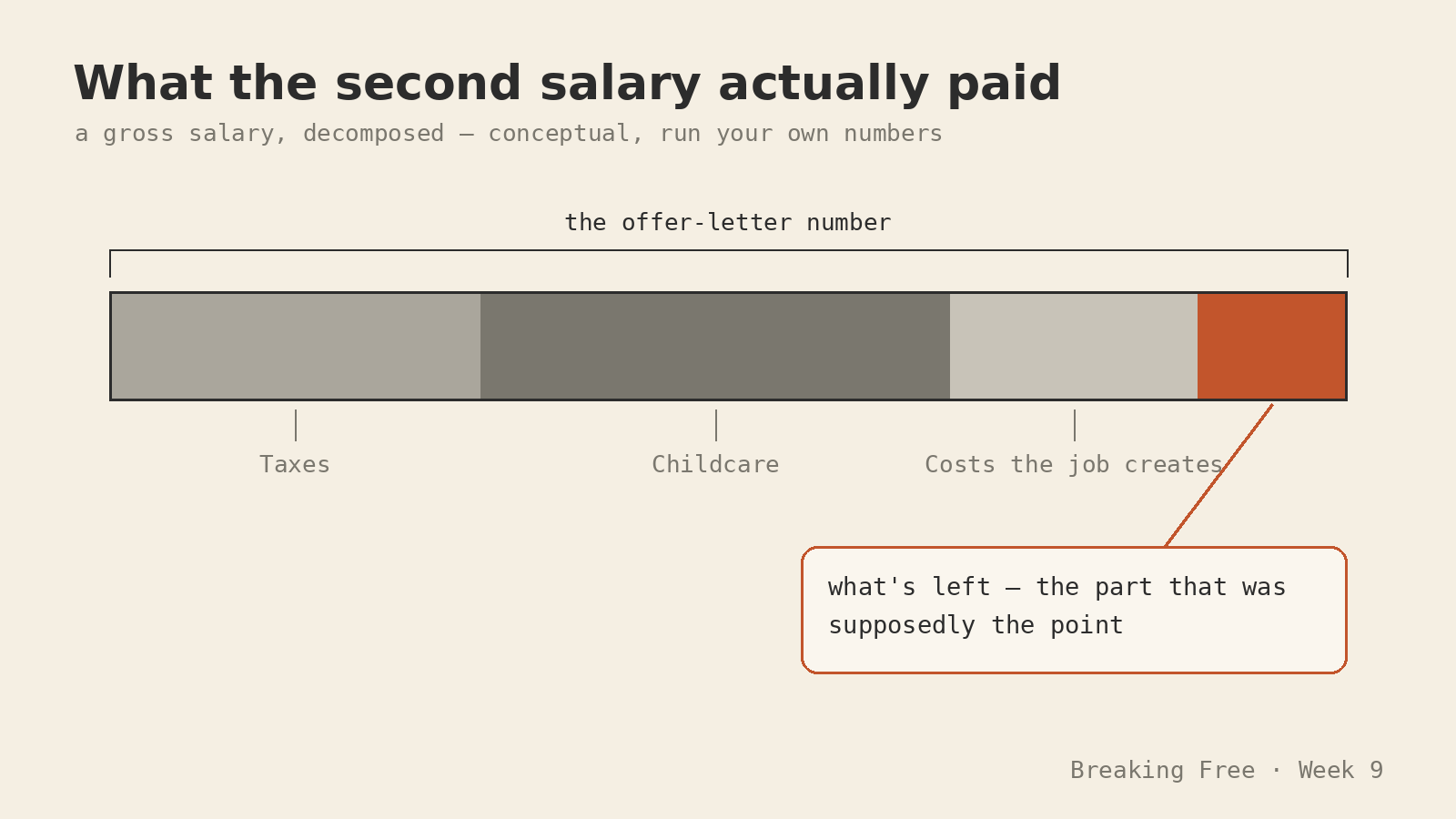
The gross number at the top of the offer letter, decomposed: taxes first, then childcare, then the costs the job itself creates. The remainder — the part that was supposedly the point — is smaller than anyone tells you.
Line three: divide by the real hours
Whatever survives lines one and two, divide it by the hours the job actually takes. Not the contractual forty — the real count: the commute on both ends, the early calls, the evening you’re home but not back. That’s your real hourly wage for staying employed while paying for care.
When I ran our version, the result wasn’t zero. I want to be careful — this isn’t one of those posts claiming the second income nets to nothing for everyone, because sometimes it doesn’t. But the number staring back at me was small. Insultingly small. The kind of small where you look at the best hours of your day, being handed to someone else, and ask what exactly they were being traded for.
The salary wasn’t buying what it claimed to buy. The job was mostly paying for itself.
Line four: underwrite the other side too
If last week’s PE letter taught anything, it’s downside first — and that cuts both ways. Quitting has real costs, and pretending otherwise would make this a pamphlet instead of a model.
Walking away pauses the retirement match and the compounding behind it. It can mean re-pricing healthcare. It creates a resume gap that a future interviewer will ask about — I’m living that line item right now, and it’s not imaginary. Career earnings compound; years out have a price that arrives later, with interest.
Put all of it in the model. The math doesn’t say leaving is free. It says the price of staying was different from the sticker — and you deserve to see both real prices before defaulting to either.
In our house, the honest version still cleared, decisively. But the reason it cleared wasn’t only in the spreadsheet. That’s Friday’s letter.
This week: run your own four lines
One envelope, one evening:
-
After-tax the big cost. Whatever the decision is — childcare, a commute-driven second car, a job you keep from inertia — price it in gross salary at your true marginal rate, not your average one.
-
List what the job buys to exist. Commute, gear, compensation spending. Be embarrassing about it. The list is longer than you want it to be.
-
Divide by real hours. Contract hours are fiction. Count the whole footprint.
-
Then underwrite the exit. Match, healthcare, compounding, re-entry risk. Both sides, honestly.
You don’t need software. You need one honest envelope and the willingness to look at what it says.
(That said — I’m building the software anyway. A free calculator that runs these four lines on your numbers is coming in the next few weeks. Subscribers get it first.)
I ran numbers professionally for seventeen years. These four lines are the only ones that ever changed my life.
Keep reading
The human side of this calculation is No Catch-Up Contributions: the part of the decision the envelope could not price.
If you want to run the time side of the calculation on your own work, use the Value of Your Time calculator. For the tax mechanics behind the first line, read Zero Is a Legal Number.
Continue with No Catch-Up Contributions: why the math gave permission, but something else made the decision.
If a friend forwarded you this, Breaking Free is two short letters a week about money, time, and getting off autopilot. Subscribe and you’ll never miss the pair.
Reply and tell me: Have you ever run the real math on the second income — and if you haven’t, what’s stopped you?
— Ashleigh