Tuesday’s ledger had one line I moved past quickly: we made more real friendships in two years in Lisbon than in the fifteen years before it.
That’s the line people write back about. Not the housing numbers.
It’s the same response I got when I wrote that community is the asset nobody puts on the balance sheet. Almost nobody disagreed. And almost everybody, in one phrasing or another, said the same quiet thing: I know. I just don’t know how it got this bad.
That question followed us back to California. I now teach a morning at the kids’ preschool and play in a weekly soccer group with mostly the same men. Neither felt natural at first. I wanted to skip more than once. But both made the lesson obvious: friendship grows when the same people keep showing up, not when everyone waits to feel less busy.
A life with no accidental contact
Adult friendship needs three simple things: repeated contact, something shared, and enough time together to stop performing. I understood that only after watching those ingredients appear in one city and disappear in another.
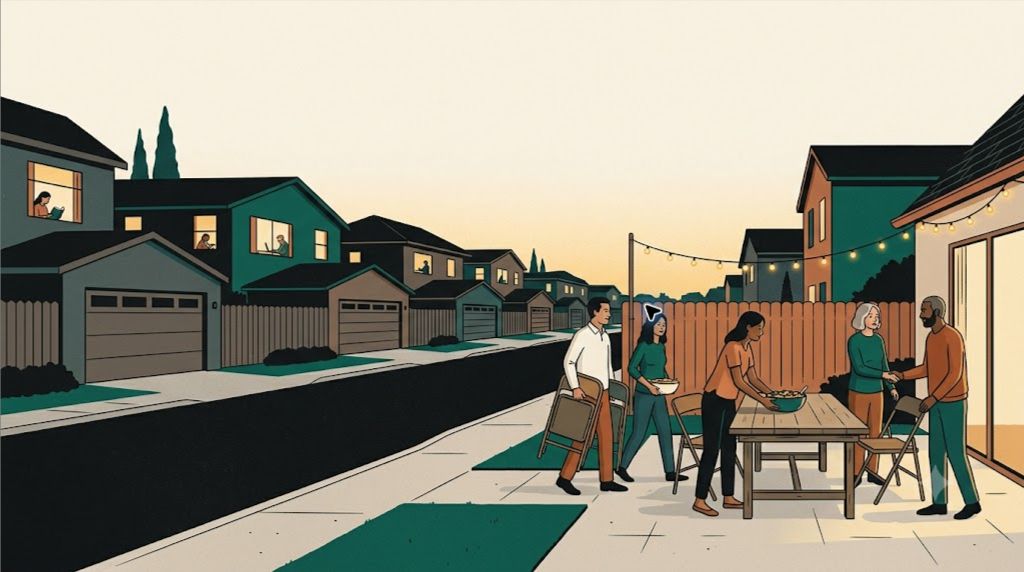
The suburbs that reward your success are built for privacy. An attached garage lets you live somewhere for years without ever being accidentally around your neighbors. Remote work removed the last room where the same people showed up every day without an agenda. The family calendar became a logistics operation — loving, necessary logistics — where every hour is assigned and almost none is left open.
Then the feed offered the feeling of social contact without the risk or effort of being known. You can end an evening having “caught up with” thirty people and been known by zero.
Nobody chose this as a friendship strategy. We made reasonable decisions one at a time, then looked up and realized we had built lives where seeing a friend required a calendar invitation.
Convenience keeps the drought going
The default keeps winning because real friendship is inconvenient.
Every real friendship I’ve made asked me to show up when the timing was bad, the drive was long, or the first few conversations were awkward. That isn’t a flaw in the process. Showing up when it would be easier not to is how adults begin to trust one another.
We have spent twenty years removing those small points of contact. We skip the waiting room, order the errand to our door, work from home, and rush through school pickup. Each change makes a day easier. Together, they leave fewer places where the same people keep running into one another.
We tell ourselves we’re too busy, and the calendar agrees. But look honestly at where your week goes and the hours are usually there. They’re being spent on easier substitutes that are always available right now. Those substitutes win the evening and lose the decade.
And it isn’t only the hours. It’s the energy. Friendship asks for the good kind — alert, present, willing to care about someone else’s week — and by nine o’clock most of us are rationing what’s left. The feed asks for none of it. That’s the competition.
What Lisbon showed me
When we lived in Portugal, we made more real friendships in two years than in the prior fifteen. I don’t credit the tiles or the weather. Lisbon’s expat community accidentally rebuilt the three ingredients: people had unusual schedules, so unplanned contact was normal; many had jumped some version of the same cliff, so the context was shared; and job titles carried less weight, so the performance dropped fast.
It wasn’t magic. It was repeated contact.
That matters because we’re back in California now, and I’m rebuilding at forty-something from scratch. I didn’t move abroad to make friends, and you don’t have to. The move simply made the mechanism visible.
So far, I have two recurring places.
One is the preschool morning. The other is weekly soccer. Neither is remarkable. That is the point.
After enough ordinary repetitions, the parking-lot nods became conversations. The soccer group started to feel like a place I belonged. Slowly, but unmistakably.
Lisbon made that happen by accident. Back in California, I have to put it on the calendar.
Stop shopping. Start hosting.
“Finding your tribe” sounds as if the community already exists somewhere, fully formed, waiting for you to discover it. Sometimes it does. Usually, someone has to organize the thing.
There is no reason that person can’t be you.
The standing dinner. The Saturday ride. The monthly fire pit. Every durable community I know has one person who keeps sending the invitation even when last time was only okay. That person isn’t waiting for community. They’re making the next Tuesday happen.
This can’t be outsourced, and it can’t be bought. You can buy proximity, memberships, and attention. You cannot buy the accumulated Tuesdays that make someone your friend.
Price it honestly, because it is expensive. A real friendship — the kind where you get the call at eleven at night — takes hundreds of hours. Not leftover hours, either. Good ones. Spent over years, with no guaranteed return and no way to rush the schedule.
Money and time are the same currency in two denominations. Energy is the third, and every worthwhile relationship asks for it.
I have never found a better return on those hours: someone who knows the whole story, shows up without being asked, and makes an ordinary decade feel like it had witnesses.
The time is expensive. It is still one of the best things you can spend it on.
This week
Put one recurring, in-person thing on the calendar. Join one that exists, or start one and invite three people who would not otherwise meet.
Two rules: it repeats on a schedule, and you don’t evaluate it until you’ve shown up eight times. Not once — eight.
The first three may be awkward. That isn’t failure. It is what being new feels like.
Eight isn’t a magic number. It’s just long enough that you can’t quit on the evidence of one bad Tuesday.
Nobody is coming to befriend you. That’s the bad news, and it’s also the assignment.
You can’t buy a tribe. You can only keep showing up until you have one.
Keep reading
Start with Moving to Portugal Was the Conservative Choice for the financial and family decision that created the Lisbon chapter.
For the first version of this idea, read Community Is the Asset Nobody Puts on the Balance Sheet. If rebuilding your life also means rebuilding your identity, continue with The Cliff Is Not Where You Think.
Next Tuesday: the income ladder — building something that pays you without needing you, from someone rebuilding one right now.
If a friend forwarded you this, Breaking Free is two short letters a week about money, time, and getting off autopilot. Subscribe and you’ll never miss the pair.
Reply and tell me: What’s the recurring thing you could start — not join, start — and who are the first three people you’d invite?
— Ashleigh