
When we told people we were moving to Portugal with two small children, the reaction was usually some combination of excitement and concern.
Then came the practical question: How can you afford to do that?
I understood why people asked. Moving abroad sounds like something you do after you’ve made enough money — a reward waiting on the other side of decades of work.
But for us, it wasn’t just about the money.
We were looking at paying roughly $50,000 a year for other people to care for our children while we worked. We had always said we would travel when we retired, but we wanted to experience more of the world while our bodies were still relatively young and energetic — and while our children were young enough to come with us.
Then a close neighbor, whose children were only a little older than ours, became terminally ill.
That changed the weight of waiting.
My spouse could take the same West Coast job and the same salary to Lisbon. Our largest expenses would fall. Our children would live within walking distance of their grandparents. I could step away from my salary and spend those early years with them without watching our savings disappear at the same rate.
The move wasn’t a splurge we had finally earned. Financially, it was one of the more conservative decisions we had made. Later, when my spouse left her job and we began living off our investments, it also came with additional tax advantages for our particular situation.
More importantly, it was a choice about what we wanted to do with our money, our time, and the healthy years we could not assume would always be waiting for us.
The question eventually turned around:
How could we afford not to move?
The number that changed
In California, we easily spent more than $10,000 a month — even though we rarely ate out or spent much on entertainment. We still prioritized gear and adventure, because those were things we genuinely valued.
In Lisbon, our spending ranged from roughly $4,000 to $8,000 a month, depending on how we chose to live. At the lower end, we kept things simple. At the higher end, we paid for nicer accommodation, ate out more, traveled around Europe, and said yes to other upgrades.
Even our more expensive months in Lisbon generally cost less than an ordinary month in California — and we were doing more of the things people usually imagine they have to spend heavily to enjoy.
Housing drove much of the difference. In and around Lisbon, we paid anywhere from about $1,200 a month for a furnished place just outside the city to $2,500 for a furnished place in a nicer area. In Santa Barbara, we were seeing $3,500 to $5,000 a month — and those places came unfurnished.
But it wasn’t only housing. Groceries were cheaper. Eating out was cheaper. We didn’t need a second car because we could walk through most of our week.
There’s a name for this: geographic arbitrage. Earn against the cost of living in one place, then build your life somewhere the same income goes further.
In FIRE — financial independence, retire early — geographic arbitrage is often treated as a way to reach the finish line faster. Lower expenses work from both directions: you can save more each month, and you need a smaller portfolio to support your life. It brings the tipping point closer.
All of that was true for us. But we weren’t willing to save all the living for retirement.
Because I wasn’t earning a salary, every dollar we no longer needed each month bought us time right then. It helped pay for the no-salary season I wrote about in the origin story — without turning each month into an emergency.
That extra time wasn’t empty. We worked out more. We took better care of ourselves. Between us, we learned Portuguese, learned to code, built new skills, and finally started — or committed properly to — the passion projects that work had kept pushing to the edges.
It also gave us enough distance to think about what our next chapter should be.
Too often, we are so busy doing the work that we never stop to ask whether it is still work we want to do. A full calendar can keep that question away for years.
These pursuits were investments we were making with our time. Their return wasn’t another line in the portfolio. It was better health, new capability, and a clearer idea of what we wanted to build next.
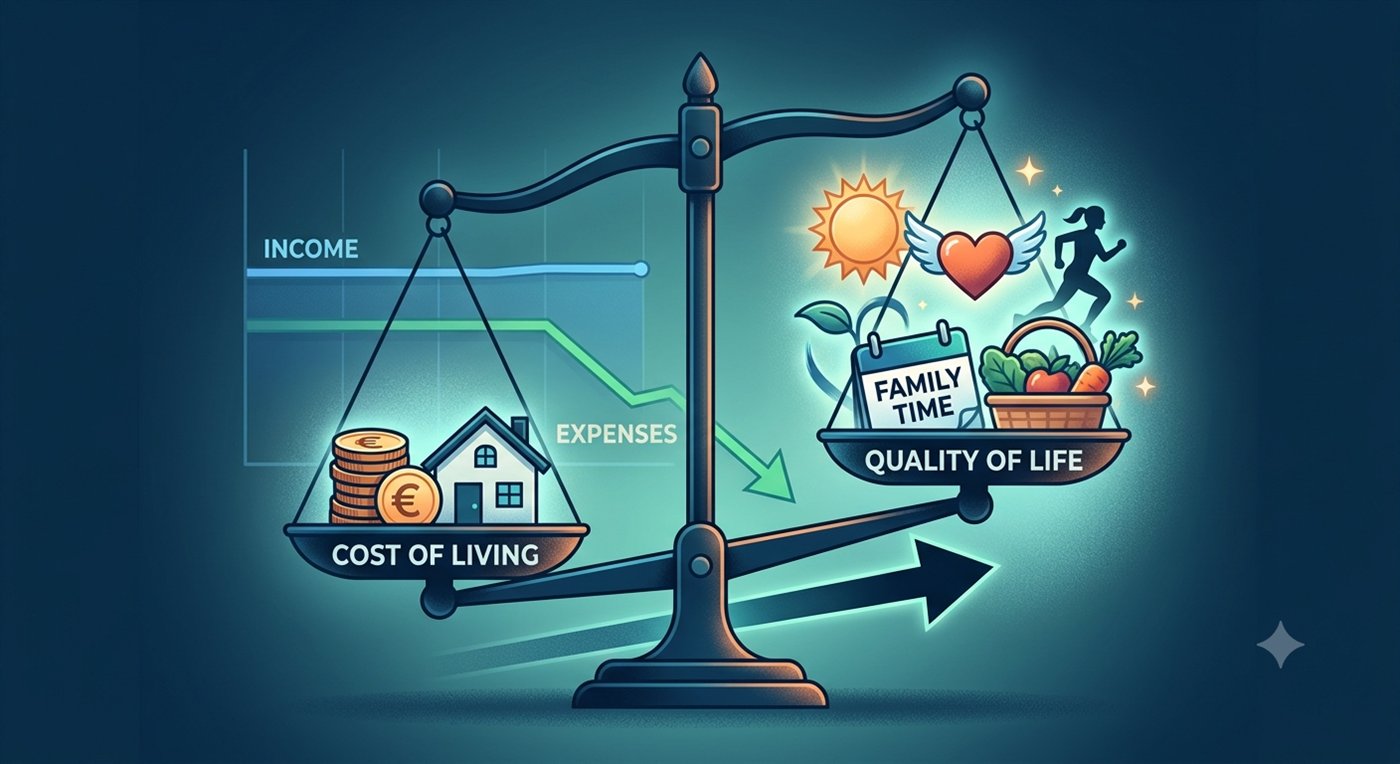
The salary stayed the same. The amount our life required did not.
It wasn’t free money
The cleaner version of this story is that we took an American salary to a less expensive country and pocketed the difference.
The real version had more friction.
We spent roughly $10,000 making the move: visas, documents, flights, baggage, and all the small things you discover you need only after arriving.
It could have been much more if we hadn’t pared our life down to twelve checked bags. When you’re moving a family across an ocean, the cheapest airfare isn’t always attached to the cheapest flight. Sometimes it’s the ticket that includes the most luggage.
The surprise cost came before we even left. Our visas arrived late, which pushed back our flights and forced us to find longer-term temporary housing while we waited. If you’re moving somewhere known for taking its time with paperwork, build delays into both the schedule and the budget.
Ahem, Portugal.
Those were not recurring expenses, but they were real. Spread over the time we lived there, they belonged in the calculation.
Working West Coast hours from Lisbon also came with a cost that doesn’t appear on a bank statement. My spouse’s workday ran through the Lisbon evening, while I became a stay-at-home dad to a six-month-old in a country we were still learning how to navigate.
Staying home with a baby was much harder than my regular job had been. I was trying to cook, care for our child, and keep a curious six-month-old out of the “office” while my spouse worked US hours on the other side of the door. Moving a baby abroad was no small task.
The days together were long, rewarding, and exhausting — often all three at once. The reward was well worth it. But I wouldn’t describe the time as a break.
Taxes became more complicated, not less. US citizens abroad still generally have US filing obligations, alongside whatever the country where they live requires. Treaties, exclusions, and local tax programs change. Portugal’s rules have changed since we moved, which is reason enough not to build a life around an old article or somebody else’s tax arrangement.
Verify the current rules for the current year and your own circumstances before putting them into your plan. This isn’t personalized financial or tax advice.
And distance costs money. There are flights home for weddings, funerals, holidays, and the moments you don’t want to miss. We learned to treat those flights as part of living abroad, not as surprise expenses.
My career pause had a cost too. I knew it would. I wrote about that trade in What the Second Salary Actually Paid. Leaving it out would have made the move look cheaper — but it would also have made the calculation dishonest.
When the time came, finding a job again was less scary than I had imagined. Returning to work was still quite an adjustment, but the pause did not make me unemployable or close the door behind me the way I had feared it might.
The spreadsheet kept calling this zero
Our children’s grandparents were in Lisbon.
There was a financial benefit to that. Family nearby changed the childcare arithmetic. But the financial benefit wasn’t the reason that line mattered.
Two small children got ordinary time with their grandparents. Not a rushed visit arranged around a holiday. Tuesdays. School pickups. Familiar routines. The kind of time that doesn’t announce itself as important while you’re living it.
There is no clean market price for that, so a spreadsheet is tempted to enter zero.
Zero is obviously the wrong number.

Private health insurance in Portugal cost about $250 a month for our family of four, including dental and vision. In our experience, the care met or exceeded the level of service we had received in the US.
At my previous job, only the employee’s coverage was paid by the company. Covering our family cost more than $2,500 a month — and we were still responsible for the first $5,000 of medical costs each year on top of that.
In the US, a medical issue had always carried a second fear: what it might do to us financially. In Portugal, that was a fear we no longer carried.
Then there was community. We made more real friendships in two years than we had in the prior fifteen. I wrote more about that in the community letter.
That wasn’t a pleasant side effect of the move. It became part of what the move was worth.
We left ourselves a way home
We never treated Portugal as a life sentence. That’s a habit from the old career: we never underwrote a deal without knowing what would make us sell it.
Before we went, we talked about what might eventually bring us back and left ourselves room to change our minds.
For us, the deciding factor was a need for higher education — probably something fairly specific to our story. We also sometimes missed the sheer range of activities available back home. That may have been Portugal, or the particular place we chose, or simply that we never found the right crowds. I don’t know that I can separate those cleanly.
Early this year, the calculation changed. We returned to California.
Coming home didn’t mean Portugal had failed. It meant the move had been right for a particular season, and we allowed that season to end.
Leaving ourselves a dignified way back made Portugal an experiment rather than a gamble. We didn’t have to defend the decision forever just because we had once made it publicly.
Run one version of the life you didn’t choose
You don’t have to want Portugal. Pick one plausible alternative: another country, another state, or the smaller town two hours away.
Then spend an evening looking at four things:
-
Would your income travel, fall, or disappear?
-
What would happen to housing, healthcare, school, food, and transportation?
-
What would it cost to make the move and, if necessary, move back?
-
What would change for your family, community, health, and time?
Count both sides. A cheaper house doesn’t automatically make a better life. Neither does a higher salary.
You may run the numbers and decide to stay exactly where you are. But at least you’ll know you stayed because the life still fits — not simply because it was already in progress.
Moving didn’t solve everything. It created new complications, put an ocean between us and people we loved, and cost more upfront than the fantasy version suggests.
It also gave our children ordinary Tuesdays with their grandparents. It gave us a community we hadn’t found in California. And it gave me room to stop earning for a while without turning every month into an emergency.
Eventually, the calculation changed and we came home.
A place can be right without having to be forever.
Keep reading
The decision began with What the Second Salary Actually Paid and the expiring window described in No Catch-Up Contributions.
For the tax side of a no-salary season, read Zero Is a Legal Number. For what Portugal taught us about adult friendship — and what rebuilding it in California now requires — continue with Where Did Everybody Go?.
Continue with Where Did Everybody Go?: the friend drought is not your fault. It is still your problem.
If a friend forwarded you this, Breaking Free is two short letters a week about money, time, and getting off autopilot. Subscribe and you’ll never miss the pair.
Reply and tell me: What place have you dismissed without ever running the real numbers?
— Ashleigh