Subtitle: You are not deciding whether to leave. You are deciding how long you can afford to be wrong about what comes next.
Years ago a building came across my desk in Denver — about four hundred units, bought with the proceeds of a brick complex in North Carolina we had just sold. Roughly thirty of those units sat under a land-use agreement that capped what we could charge for them, with the caps stepping off at year five and again at year ten. Most bidders read a rent cap as a ceiling and move on. Read it as a timer instead and the value is already inside the building; it is just locked behind a date, and you get paid for being willing to wait.
That isn’t the part I want you to take.
The part I want you to take is the question we ran before we bid, which was never what does this return if it works. It was: how far can rents fall, how high can vacancy climb, how long can this survive being wrong. We underwrote to something like a fifteen percent decline in rents — and the number that matters there isn’t fifteen. It’s that fifteen was where the deal stopped being comfortable, not where it died. The gap between those two is the entire discipline. Most people plan to the edge of what works and call it a plan.
I did that for a living. Then in 2022 I resigned from a seventeen-year career, and I can tell you precisely which model I never built.
”Can I quit?” is the wrong size of question
The standard advice — don’t leave until you have the next thing lined up — is not wrong. It’s advice for protecting a career, which may not be the thing you’re actually trying to protect. If the job is taking the evenings, or you’re paying for childcare so you can keep earning the money that pays for the childcare, “line up another one” answers a question you didn’t ask.
The harder case is the job you’re good at. A bad manager hands you permission to leave. A respectable job you’ve outgrown keeps producing evidence that staying is the responsible choice, and it will keep producing it indefinitely.
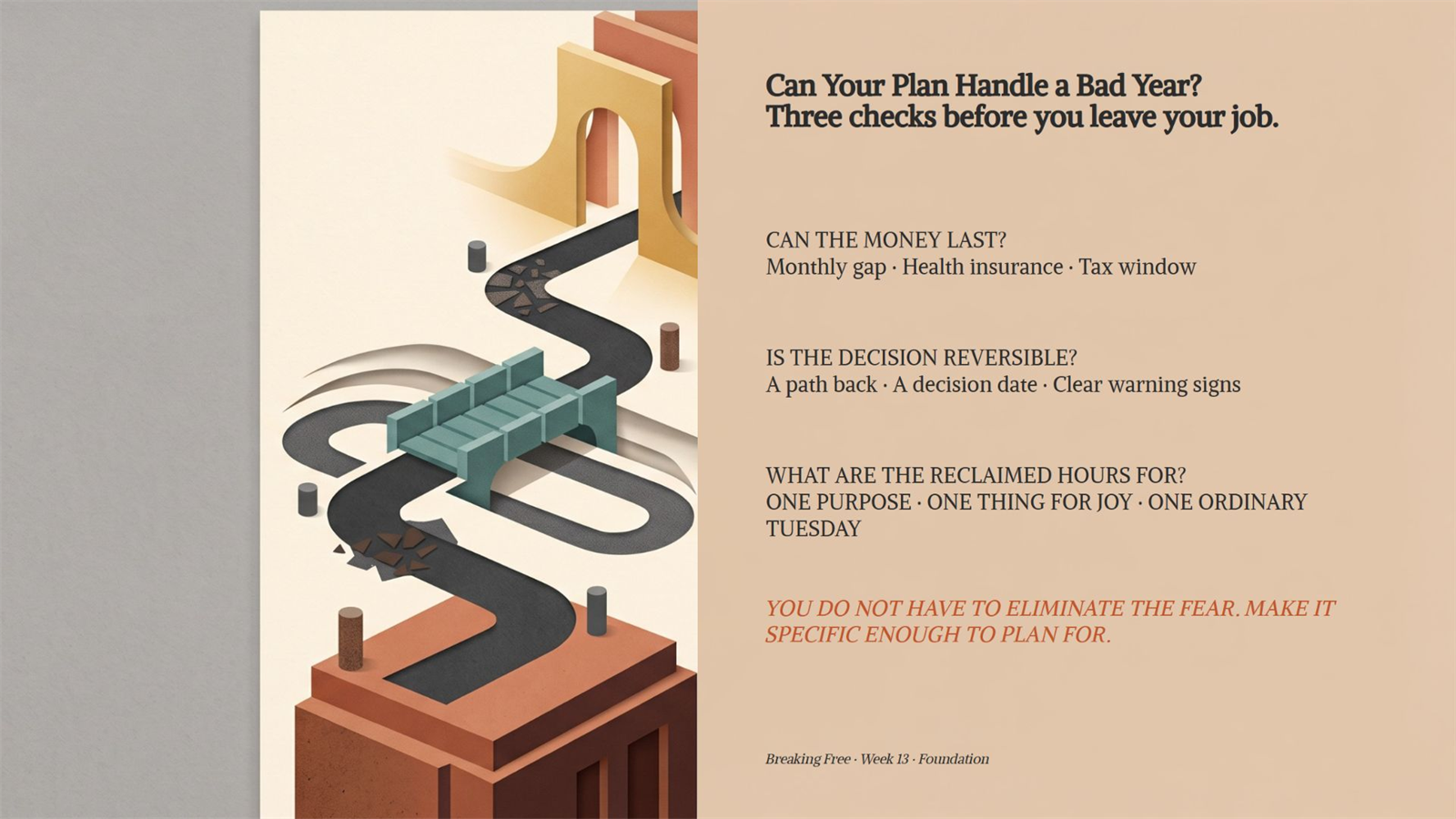
But can I quit bundles money, health insurance, identity, your spouse’s tolerance for risk, the tax year, and the possibility that you’ll want to work again into one dramatic yes or no. No wonder it never resolves. Break it into five questions that can actually be answered this month:
- What does one month without this salary genuinely cost?
- Which income and benefits continue after the last paycheck?
- What money will I refuse to spend, no matter what?
- What does a low-income year make possible that a high-income year doesn’t?
- What evidence would make going back feel like an option rather than a defeat?
You don’t need certainty. You need enough honest information to stop treating every unknown as the same size.
Price the month, not the year
I laid out the arithmetic in The Runway Number and won’t rebuild it here: deployable cash over honest floor, sized for signal rather than replacement, with the reserve carved out first because a bad month shouldn’t become two crises. The free Career-Break Planner holds all of it in one place — cash, protected reserve, transition costs, and the conditions that would change your mind.
One thing to add on top of it. The shortfall is not your spending — it’s your spending minus what reliably continues, and the continuing part is usually larger than people assume. A partner’s salary. Rent from a unit. Two consulting days a month. Some costs go the other way and disappear with the job: commuting, the wardrobe, the lunches, the childcare hours you were buying in order to be somewhere else. Others arrive all at once in month one, which is where a move, a laptop, or a deposit lands.
If you have never put a rate on the hours this job actually consumes — the commute, the evening it takes to recover from, the help you buy in order to keep doing it — the free Real Hourly Wage Calculator will give you a number that makes the rest of this arithmetic land harder.
Then build it three times. The version you expect. The version where costs run fifteen percent over and income shows up three months late. And the balance or the date at which you change plan.
That third one is not pessimism. It’s what turns leaving into a bounded experiment instead of a leap, and a reversible decision is dramatically easier to make than a permanent one — which is the actual reason to write it down.
Give the insurance its own line
If you’re in the US, price health coverage before anything else on this list, because it’s the item most likely to be sitting in “miscellaneous” carrying four figures a month.
Get real quotes for the actual choices in front of your household — a spouse’s plan, COBRA, the marketplace. Compare the premium, the deductible, and whether your doctors are in the network, which is the part people discover in March. Keep that estimate beside the tax and income decisions that follow so you do not evaluate one change in isolation.
This is the least interesting paragraph in the post and the one most likely to change your date.
The low-income year is an asset, if you notice it in time
A year without a salary is not financially empty. It can be the most valuable planning year you get.
Wages are no longer filling your ordinary-income brackets. That opens room — realizing long-term gains at a lower rate, converting part of a traditional account to Roth, timing deductions and income deliberately rather than accepting whatever the payroll calendar hands you. But the size of the room depends on filing status, your basis, state residency, business income, and the health-insurance assumption above, so the question isn’t how do I get my tax bill to zero. It’s what becomes available when my income changes, and what else does it touch?
Before the salary stops, put one page together: expected ordinary income for the year, unrealized gains in taxable accounts, traditional balances you could convert, likely state residency, your health-coverage estimate, and any consulting income you might create. Take the page to someone who can look at your actual situation.
Rules and thresholds move every year. Verify current figures before you act on any of this — including anything you read here. General education, not personalized advice, and I’m not your accountant.
Underwrite the way back
The fear underneath most career breaks isn’t running out of money. It’s becoming unemployable, and it goes unpriced because saying it out loud feels like admitting you don’t believe your own plan.
You can’t eliminate that risk. You can stop leaving it as a dark shape in the corner. Write down three people who would take your call in eighteen months. Two skills you’ll keep current without the break turning into another job. One small paid project you’d accept. The date you’ll assess whether re-entry should start. And the minimum role, schedule, and money you’d come back for — decided now, while nobody is asking.
None of that commits you to working. It’s evidence that the bridge exists, and the evidence is what lets you spend the runway on the thing instead of on worrying about the runway.
I’ll go further, because I’ve now tested it. I went back to work. Not because the plan failed, but because a job turned out to be a line of credit against my own time — a lever I could pull without unwinding anything I’d built, and it came with skills the next chapter needed. Knowing that lever is there is what makes the aggressive part of the plan survivable. Which is uncomfortable, since the entire point of leaving was to stop trading hours for money, and the willingness to trade them back is exactly what makes the freedom safe.
Put a date on it
Deadlines only own the people who lack the reps.
On the Denver deal we had a 1031 window pushing us toward any deal and a rent-step structure rewarding a long hold — two clocks running opposite directions. What resolves that isn’t nerve. It’s having done enough of them to know you can hand the money back and walk away, because the tax savings are always second to whether it’s a good investment. Experience is what turns a deadline back into a date.
You don’t have those reps on your own exit. You get one. So build the substitute: a date on the calendar when you decide, and pre-committed triggers for what changes at half the runway and at a quarter of it. At 50% with nothing working, I take contract work two days a week and extend. Not “at 25% I’ll figure it out,” which is what everyone writes and nobody executes.
A date is also the only real defense against the failure in The Cost of One More Month: the person who is not stuck, only preparing, for five years.
The triggers don’t exist to make you quit the plan. They exist so that continuing stays a decision rather than a drift.
Then decide what it’s for
One more, and it’s the one people skip because it has no number attached.
Name one thing this break is for, one thing it is not for, and one ordinary Tuesday you want it to make possible. Being the parent at pickup at three. Getting your health back. Testing whether the business is real. Finding out whether another country fits the life you keep describing. Not a productivity plan — a season, with a shape.
That Tuesday will do more work than the runway will. And I’ll be straight with you about the limit of this exercise: naming a direction now is not the same as knowing what the time is for. Some of that only becomes audible after the calendar is actually empty, which is Friday’s post and the part that took me longer than the money did. Name what you can today anyway. A rough direction beats an open question, and it is the difference between a break and a drift.
So: this week, price one thing. Get the insurance quote. Run the honest floor. Ask the former colleague for coffee in the vague future. Book the tax meeting. Circle whichever of the five questions above you’re least willing to answer, because that’s the one keeping you where you are.
The goal was never to be unafraid. It’s to make the fear specific enough to underwrite.
Keep reading
Run the arithmetic in The Runway Number, then bound it with the free Career-Break Planner. Neither will tell you to quit. A spreadsheet should never pretend it can make a human decision.
If you want one number to start from, the free Real Hourly Wage Calculator prices the hours you are currently trading.
If the worry is the version where you leave and thrift quietly becomes the new job, that one is Frugality Got Me Free. Then It Became the Cage.
Friday’s companion is The Resignation Is Not the Escape Plan — what happens after the calendar empties, and why the letter is the only part of this that isn’t a plan.
Reply and tell me: which unknown is doing the most work in keeping you where you are?
— Ashleigh